
California Health and Safety Code § 11352: Sale or Transportation of Controlled Substances
Health and Safety Code § 11352 makes it a severe felony to sell, transport for sale, furnish, administer, give away, import into California, or offer to perform any of these acts involving specific controlled substances.
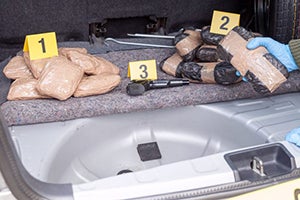
Commonly referred to as a drug trafficking or distribution statute, HS 11352 primarily targets illicit narcotics such as heroin, cocaine, crack cocaine, opiates, and unauthorized prescription medications (like Vicodin or OxyContin).
Simple possession for personal use is governed by a completely different law, meaning the core focus of HS 11352 is the commercial movement and distribution of narcotics.
Quick Reference Summary: HS 11352 Statutory Overview
|
Statute |
Base Sentence Exposure |
Key Evidence of Intent to Sell |
| HS 11352 | 3, 4, or 5 years in county jail |
• Large quantities of narcotics • Scaled weights & packaging baggies • High sums of cash • Digital communications organizing sales |
Legal Elements: What the Prosecutor Must Prove
To secure a conviction under HS 11352, the prosecution must prove four essential facts beyond a reasonable doubt:
-
The Prohibited Action: The defendant sold, transported for sale, furnished, or imported a controlled substance.
-
Knowledge of Presence: The defendant knew the drug was present (e.g., it was inside their car or bag).
-
Knowledge of Drug Nature: The defendant was aware that the substance had the characteristics of a controlled substance (even if they did not know its exact chemical name).
-
Verifiable Drug Identity: The material was a controlled substance covered specifically by this statute.
Crucial Rule on Transportation: Moving a drug across town or across state lines is a violation of HS 11352 only if the movement was specifically intended to sell or distribute it. Moving a personal supply is a lesser offense.
Real-World Example of an HS 11352 Violation
An individual is stopped by law enforcement in Los Angeles County for a broken taillight. During the inspection, officers discover a backpack containing bricks of cocaine wrapped in plastic, a digital scale, and a notepad listing dollar amounts and client names.
Because the driver moved the narcotics from point A to point B with clear intent to distribute, they will be charged with transportation for sale under Health and Safety Code § 11352.
Conversely, if the driver had just a gram of cocaine loose in their pocket, without cash or packaging, they would face only simple possession charges under HS 11350.
Penalties and Sentencing for HS 11352
A violation of HS 11352 is a straight felony that cannot be reduced to a misdemeanor.
Base Jail Sentences
Under California's criminal realignment laws, sentences are typically served in county jail rather than in state prison, provided the defendant has no disqualifying violent or serious priors:
-
Low Term: 3 years in county jail
-
Middle Term: 4 years in county jail
-
High Term: 5 years in county jail
Note: If the defendant transported narcotics across noncontiguous counties (multiple non-bordering counties within California) with the intent to sell, the penalty increases to 3, 6, or 9 years in state prison.
Weight Enhancements (HS 11370.4)
If the offense involves exceptionally large quantities of heroin, cocaine, or cocaine base, prosecutors can add mandatory consecutive years to the base sentence.
-
Over 1 kilogram: Adds 3 consecutive years
-
Over 4 kilograms: Adds 5 consecutive years
-
Over 10 kilograms: Adds 10 consecutive years
-
Enhancements can be extended by up to an additional 25 years for quantities exceeding 80 kilograms.
Immigration Consequences
For non-citizens, an HS 11352 conviction is catastrophic. Federal immigration authorities view this offense as an aggravated felony and a crime involving moral turpitude.
A conviction results in mandatory deportation, denial of naturalization, permanent inadmissibility to the United States, and the loss of legal permanent resident (green card) status.
Defense Strategies to Fight HS 11352 Charges
Defending against a major drug-trafficking charge requires aggressively dismantling the prosecution's evidence:
-
Personal Use Only (No Intent to Sell): Arguing that the quantity of drugs found was exclusively for personal use. If successful, this can reduce the felony trafficking charge to a simple misdemeanor possession charge under HS 11350.
-
Unlawful Search and Seizure: Filing a motion to suppress evidence under Penal Code § 1538.5. If the police stopped your vehicle or entered your property without a warrant, probable cause, or a legal exception, the physical evidence can be thrown out of court, forcing a total dismissal.
-
Lack of Knowledge: Proving the defendant was a "blind mule"—someone else hid the drugs in their vehicle, luggage, or package without their knowledge or consent.
-
Entrapment: Proving that undercover law enforcement overstepped legal bounds by using coercion, threats, or harassment to persuade a person to sell drugs when they otherwise had no intention of doing so.
To defeat a drug transportation charge under California Health and Safety Code § 11352, defense attorneys often focus on the initial traffic stop and the subsequent vehicle search.
Because vehicles are afforded a lower expectation of privacy than a home, police do not always need a warrant—but they must strictly adhere to the Fourth Amendment.
If your attorney can prove the police overstepped their legal boundaries, the judge will grant a Motion to Suppress Evidence (Penal Code § 1538.5). When the physical drugs are suppressed (thrown out), the prosecution's case collapses.
Legal Arguments Used to Suppress Vehicle Search Evidence
Unlawful Extension of the Traffic Stop (The Rodriguez Rule)
Under the landmark U.S. Supreme Court case Rodriguez v. United States, a police officer cannot extend a traffic stop beyond the time reasonably needed to address the initial traffic violation (such as issuing a speeding ticket or checking registration).
-
The Argument: If the officer resolves the traffic infraction but continues to detain you solely to ask probing questions, call a K-9 drug dog, or wait for backup without independent "reasonable suspicion" of a drug crime, the detention becomes illegal. Any evidence found after that unlawful delay is considered "fruit of the poisonous tree" and must be suppressed.
Invalid or Coerced Consent
Police officers often ask, "You don't mind if I take a quick look in your trunk, right?" If you consent, they do not need a warrant or probable cause. However, that consent must be voluntary.
-
The Argument: If the officer used threats, brandished a weapon, implied that a search was mandatory, or told you that your car would be impounded regardless, your attorney will argue that the consent was coerced. Additionally, if you consented to a search of the back seat and the officer pried open a locked container or side panel, the officer exceeded the scope of your consent, making the discovery illegal.
Lack of Probable Cause for an Involuntary Search
To search a vehicle without a warrant or your consent, police must establish probable cause—meaning a set of objective facts that would lead a reasonable person to believe contraband is present.
-
The Argument: Defense lawyers frequently challenge the officer's stated reasons for the search. For example, if the officer claims they smelled drugs, observed "furtive movements," or noted that the driver appeared "unusually nervous," your attorney will cross-examine the officer about their training, review dashcam or bodycam footage, and argue that these observations were subjective hunches rather than objective probable cause.
Illegal Stop or "Pretextual" Flaws
The police cannot pull a car over on a hunch; they must have a valid reason, such as a traffic violation or a safety hazard.
-
The Argument: If your attorney can prove that the underlying reason for the traffic stop was entirely fabricated—for example, by using GPS tracking or video evidence to show you came to a complete stop or that your taillight was functioning—the initial stop is ruled unlawful. Because the stop itself was unconstitutional, everything that followed, including the discovery of the controlled substances, is suppressed.
The Legal Reality: Judges do not consider these factors in isolation; they evaluate the "totality of the circumstances." Only by having an attorney request and meticulously review the radio logs, dispatch timelines, and bodycam footage can the minute legal errors that win a motion to suppress be exposed.
Related California Drug Statutes
-
Health and Safety Code § 11351 – Possession for Sale: Criminalizes possessing narcotics with intent to distribute them, even if an actual sale or transfer is never completed.
-
Health and Safety Code § 11350 – Simple Possession: Applies when a narcotic or prescription medication (such as Adderall or Vicodin) is possessed solely for personal use without a prescription. This is typically a misdemeanor.
-
Health and Safety Code § 11353 – Selling Drugs to a Minor: Incurring extreme prison sentences for an adult who uses, employs, or sells controlled substances to an individual under 18 years old.
-
Health and Safety Code § 11366 – Operating a Drug House: Penalizes anyone who opens or maintains a physical location to sell, distribute, or use controlled substances.
-
Health and Safety Code § 11370.9 – Drug Money Laundering: Makes it a crime to handle or structure proceeds exceeding $25,000 derived from illegal drug trafficking with the intent to conceal their origin.
-
Health and Safety Code § 11366.8 – Hidden Compartments: Prohibitions against modifying a vehicle to add a secret or false compartment designed to smuggle or hide drugs from police.
-
Penal Code § 182 – Conspiracy: Charged when two or more individuals conspire or coordinate to manage a drug distribution ring, holding all members responsible for each other's acts.
Frequently Asked Questions (FAQs)
Can I be convicted under HS 11352 if I just shared a drug with a friend for free?
Yes. The legal definition of HS 11352 includes the terms "furnish" and "give away." You do not need to make a financial profit or complete a commercial transaction to be convicted of this felony; simply handing an illicit narcotic to another person meets the statutory criteria.
Is probation an option for an HS 11352 conviction?
Yes, formal felony probation is legally possible, depending on the case's circumstances, the quantity of the drug involved, and the defendant's prior criminal record. If granted, the defendant will be closely monitored in the community rather than serving a multi-year jail sentence.
Does an "offer to sell" drugs count as an offense if I didn't actually have the drugs?
Yes. An offer to sell is fully prosecutable under HS 11352. The state only needs to prove that you made a definitive offer to sell or deliver a controlled substance with the actual intent to complete the transaction.
What is the difference between HS 11352 and HS 11379?
Both laws govern the sale and transportation of controlled substances, but they apply to different drug schedules. HS 11352 applies to street narcotics and opiates (such as cocaine and heroin), while HS 11379 applies strictly to non-narcotic stimulants and synthetics (such as methamphetamine, ecstasy, and ketamine).
Can an HS 11352 charge be negotiated down to a misdemeanor?
Because HS 11352 is a straight felony, a judge cannot directly reduce it to a misdemeanor. However, a defense attorney can negotiate a plea deal with the prosecutor to amend the charges entirely to simple possession under HS 11350, which is a misdemeanor.
Speak With a California Drug Crime Defense Attorney
A felony charge under Health and Safety Code § 11352 carries life-altering consequences, including lengthy jail terms and severe immigration consequences.
Building an effective defense requires early intervention to challenge wiretaps, traffic stops, and informant testimony.
To review your case and explore your legal options, schedule a completely confidential, free consultation with Esfandi Law Group by calling (310) 274-6529 or reaching out through our online intake form.