
California Health and Safety Code § 11366.8: Concealing Drugs in a False Compartment
Health and Safety Code § 11366.8 HS makes it a crime to possess, use, control, design, build, modify, install, or attach a false compartment in a vehicle with the specific intent to conceal, smuggle, or transport controlled substances.
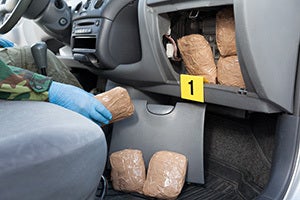
This statute explicitly targets concealed vehicle modifications—commonly called "traps"—designed to evade law enforcement detection during drug trafficking operations.
These compartments are often ingeniously integrated into gas tanks, dashboard consoles, factory side panels, or spare tire wells.
Quick Reference Summary: HS 11366.8 Penalties & Classifications
|
Offense Type |
Maximum Incarceration |
Maximum Fine |
| Possession, Use, or Control |
Misdemeanor: Up to 1 year in jail Felony: Up to 3 years in jail |
Up to $1,000 (Misdemeanor) Up to $10,000 (Felony) |
| Designing, Building, or Installing | 16 months, 2 years, or 3 years in state prison | Up to $10,000 |
Legal Elements: What the Prosecutor Must Prove
To secure a conviction under HS 11366.8, the prosecution must prove the following elements beyond a reasonable doubt:
-
Physical Existence: A false compartment was present in, or attached to, the vehicle.
-
Design or Modification: The space was fabricated, modified, or explicitly used to conceal controlled substances.
-
Knowledge: The defendant knew of the hidden compartment's existence.
-
Specific Intent: The defendant intended to use the compartment to store, hide, smuggle, or transport illegal drugs.
Note on Circumstantial Evidence: Because defendants rarely admit to knowing about a secret compartment, prosecutors routinely rely on circumstantial evidence such as vehicle ownership, tool marks, fingerprint or DNA placement, encrypted phone data, and large amounts of hidden cash to infer knowledge and intent.
Real-World Example of an HS 11366.8 Offense
A driver is pulled over for changing lanes without signaling. During a K-9 sniff search, a drug dog alerts on the rear seats.
Officers discover an electronic hydraulic system that shifts the vehicle's back panel forward, revealing a custom metal box welded behind the factory seat frame, containing 2 kilograms of methamphetamine.
Even if the driver claims they did not build the car, they can still be charged with possession and use of a false compartment under Health and Safety Code § 11366.8.
If a specific auto mechanic was found to have wired the hidden hydraulic switch, knowing it would be used to hide narcotics, that mechanic would face straight felony charges for building and installing the unit.
Penalties and Sentencing Breaks
The legal consequences of a false compartment conviction depend entirely on the defendant's specific actions:
Possession, Use, or Control
When a person simply drives or occupies a vehicle containing a hidden trap with the intent to hide drugs, the crime is a "wobbler."
Prosecutors can charge it as either a misdemeanor or a felony, depending on the amount of drugs found and the driver's criminal history.
Misdemeanor exposure is capped at 1 year in county jail, while a felony charge carries up to 3 years in county jail.
Designing, Fabricating, or Installing
If an individual actively designs, constructs, alters, or installs a secret compartment in a vehicle to assist a trafficking operation, the crime is a straight felony. This carries a mandatory sentence of 16 months, 2 years, or 3 years in California state prison.
Defense Strategies to Fight False Compartment Charges
An aggressive defense requires a detailed review of the vehicle's history and the arrest mechanics:
-
Innocent Vehicle Owner (Lack of Knowledge): If you recently bought a used car, borrowed a vehicle, or drive a commercial fleet vehicle, your attorney can argue that the compartment was built by a previous operator without your knowledge.
-
No Unlawful Intent: If the hidden box was installed to secure legal valuables, expensive tools, or legal firearms against theft, the prosecution cannot meet the required element of intent to hide controlled substances.
-
Unconstitutional Search & Seizure: If law enforcement dismantled your car panels or conducted a lengthy roadside detention without probable cause, consent, or a valid warrant, a motion to suppress evidence under Penal Code § 1538.5 can suppress all evidence discovered.
-
No Actual Fabrication: Arguing that the space used was simply a standard factory storage area (such as a deep glove box or tire well) that was not altered to serve as a deceptive concealment tool.
Related California Drug Statutes
-
Health and Safety Code § 11351 – Possession for Sale: Applies when narcotics are found in the hidden compartment, packaged for distribution.
-
Health and Safety Code § 11352 – Sale or Transportation of Narcotics: The core trafficking felony used alongside HS 11366.8 when a vehicle is transporting narcotics across county lines.
-
Health and Safety Code § 11366 – Operating a Drug House: Penalizes the maintenance of any physical infrastructure or location specifically used for drug sales or distribution.
-
Health and Safety Code § 11379.6 – Manufacturing Controlled Substances: Applies if chemical equipment or mobile drug-production apparatuses are found hidden inside altered vehicles.
-
Health and Safety Code § 11375.5 – Synthetic Stimulants: Restricts designer stimulants or bath salts, which are often transported in modified vehicle compartments.
Frequently Asked Questions (FAQs)
Can I be convicted if the hidden compartment was completely empty when police found it?
Yes. The law does not require that drugs be present in the compartment at the time of the search.
If the prosecution can use drug residue, odors, digital messages, or tools to prove the compartment was designed and intended specifically to hide controlled substances, you can still be convicted.
Can a normal factory parts storage area be considered a "false compartment"?
Generally, no. A standard factory-made glove compartment, trunk, or center console does not violate this law.
However, if a factory space is modified—such as hollowing out an airbag container or wiring a secret electronic latch into an existing storage space—the modification turns it into a false compartment.
What makes an HS 11366.8 charge a felony instead of a misdemeanor?
For possession or use, prosecutors consider the "aggravating factors."
If the compartment is highly sophisticated, contains large quantities of mid- to high-level narcotics, or the driver has a prior record of drug trafficking, the state will almost always file the charge as a felony.
How do police usually find these hidden compartments?
Law enforcement officers often locate custom traps using specialized K-9 drug units, fiber-optic scope cameras fed into panels, or by noticing uneven spacing, non-factory wiring, custom switches, or Bondo or welding marks under the vehicle frame.
Can a mechanic be charged under HS 11366.8 if they didn't know the customer was hiding anything?
No. The prosecution must prove that the builder had specific intent or explicit knowledge that the modification was intended to hide controlled substances. If a mechanic builds a hidden box believing it is strictly for high-end camera equipment or legal valuables, they lack the required criminal intent.
Speak With a Drug Crime Defense Attorney
False compartment charges are technically dense and legally complex, heavily reliant on forensic automotive examinations and police search protocols.
Securing early representation can prevent prosecutors from filing straight felony charges and help expose gaps in their evidence about your knowledge of the vehicle's modifications.
To review your case and protect your rights, schedule a confidential, free consultation with Esfandi Law Group by calling (310) 274-6529 or completing our secure online intake form.