
California Miranda Rights Violations: What Happens When Police Fail to Read Your Rights?
A Miranda rights violation occurs when law enforcement officers subject an individual to a custodial interrogation without first providing standard constitutional warnings regarding self-incrimination and the right to counsel.
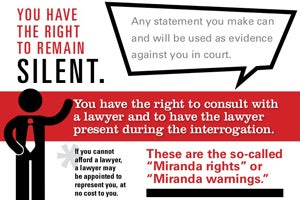
Derived from the landmark U.S. Supreme Court case Miranda v. Arizona (1966), these protections shield individuals from coerced self-incrimination guaranteed under the Fifth Amendment and Sixth Amendment to the U.S. Constitution.
If California police question you while in custody without reading you your Miranda rights, any self-incriminating statements, admissions, or full confessions obtained during that session are generally inadmissible in court.
Legal Definitions & Key Concepts
To fully evaluate whether a constitutional violation occurred, California courts look at specific statutory and legal frameworks.
-
Custody: A formal arrest or a restraint on freedom of movement to the degree associated with a formal arrest, evaluated under an objective standard of whether a reasonable person in the suspect's position would consider themselves free to leave.
-
Interrogation: Express police questioning or any words or actions on the part of police (other than those normally attendant to arrest and custody) that the police should know are reasonably likely to elicit an incriminating response from the suspect.
-
Custodial Interrogation: The exact point at which law enforcement questioning overlaps with a formal restraint on liberty, officially triggering the legal requirement to administer Miranda warnings.
-
Motion to Suppress Evidence (Penal Code § 1538.5 / Evidence Code § 402): A pre-trial procedural motion filed by defense counsel requesting the judge to exclude unlawfully obtained statements or physical evidence from being introduced at trial.
-
Fruit of the Poisonous Tree Doctrine: A legal rule establishing that evidence secondary or derivative to an initial constitutional violation may also be excluded from court proceedings.
When Miranda Rights Apply (and When They Do Not)
Police officers are not required to read Miranda warnings every time they arrest or interact with a citizen. The legal duty to read rights arises strictly when custody and interrogation occur simultaneously.
The Two Required Legal Conditions
-
Custody: You are formally under arrest, handcuffed, placed in the back of a patrol car, or detained at a police station under circumstances where a reasonable person would not feel free to walk away.
-
Interrogation: Officers ask direct questions or use statements, tactics, or physical cues designed to draw out an incriminating response regarding a suspected crime.
Exempt Scenarios (Where Warnings Are Not Required)
-
Routine Traffic Stops: Field sobriety tests, basic driver identification, or casual questioning during standard traffic detentions.
-
Voluntary Encounters: Consensual conversations on the street or in public where you are explicitly free to terminate the conversation and leave.
-
Public Safety Exception: Emergency questioning aimed at locating a weapon or neutralizing an immediate threat to public safety (New York v. Quarles).
-
Booking Questions: Administrative questions asked during processing (e.g., name, date of birth, address, emergency contact).
Penalties and Legal Consequences of a Miranda Violation
While a Miranda violation is a breach of constitutional procedure rather than a criminal charge against police, it carries severe legal remedies that impact the prosecution's case.
Suppression of Inculpatory Statements
Under California Evidence Code § 402, the judge will grant a defense motion to suppress statements obtained without Miranda warnings. The prosecutor cannot introduce those admissions or confessions during their primary case (case-in-chief).
Exclusion of Derivative Evidence
If unconstitutionally obtained statements directly lead law enforcement to discover physical evidence, that physical evidence may also be excluded under the fruit of the poisonous tree doctrine, unless prosecutors can prove it would have been discovered inevitably (inevitable discovery rule).
Weakened Prosecution Case & Dismissals
A Miranda violation does not automatically cause charges to be dropped. However, without the defendant's confession or self-incriminating remarks, the prosecution may lack sufficient evidence to prove guilt beyond a reasonable doubt, frequently leading to:
-
Voluntary dismissal of charges by prosecutors
-
Charge reductions during plea negotiations
-
Directed verdicts of acquittal by the judge
Understanding Miranda Waivers: Express vs. Implied
Before law enforcement can question an in-custody suspect, they must secure a valid waiver of constitutional rights.
-
Knowing: This requires the suspect to fully comprehend their rights, preventing questioning when language barriers, severe intoxication, or cognitive impairments exist (e.g., an officer reads the warnings in the suspect's native language and explicitly confirms their understanding).
-
Intelligent: This requires the suspect to understand the direct legal consequences of speaking, confirming they realize their statements will be used by prosecutors in court (e.g., a suspect explicitly states, "I know what I say can hurt me in court, but I'll talk anyway").
-
Voluntary: This requires the waiver to be executed freely without police coercion, physical threats, or improper promises of leniency (e.g., a suspect agrees to answer questions without officers using threats or offering illegal immunity).
-
Express Waiver: This occurs when a suspect gives clear, unambiguous verbal or written confirmation waiving their constitutional rights (e.g., check-marking "Yes" to questioning and signing an official police waiver form).
-
Implied Waiver: This occurs when a suspect's waiver is inferred through their actions and uncoerced responses after hearing their rights, as held in Berghuis v. Thompkins (e.g., a suspect nods, stays quiet initially, and then freely begins answering questions).
Hypothetical Examples of Miranda Violations
-
An individual is arrested for residential burglary, handcuffed, and placed in a police interrogation room. Officers question them for two hours about the stolen property without reading Miranda rights, resulting in a recorded confession that defense counsel successfully moves to suppress.
-
A suspect pulled over for suspected DUI voluntarily answers preliminary questions on the side of the road before any arrest occurs; these pre-custodial statements are fully admissible in court because the suspect was not under custodial interrogation.
-
An arrestee invokes their right to counsel by stating, "I want a lawyer," but police continue questioning them after a 20-minute break, rendering all subsequent statements inadmissible due to a clear Miranda invocation breach.
Related Laws, Crimes, and Legal Considerations
Miranda violations often arise during investigations into distinct criminal offenses or in tandem with constitutional search issues. Understanding how related charges interact is critical because police misconduct during questioning can impact multi-charge cases.
-
Penal Code § 148(a)(1) (Resisting Arrest): Covers resisting, delaying, or obstructing a peace officer executing their duties. Allegations of resisting often occur right before or during custodial arrests where improper interrogations take place.
-
Penal Code § 69 (Obstructing an Executive Officer): Involves using threats or violence to deter or prevent an officer from performing duties. Disputes over custody timing in PC 69 cases frequently affect whether statements made during physical altercations require Miranda warnings.
-
Penal Code § 422 (Criminal Threats): Making threats of death or great bodily harm. Statements in PC 422 investigations are heavily scrutinized for voluntariness during station-house interrogations.
-
Penal Code § 211 (Robbery) & Penal Code § 187 (Murder): Serious felony offenses where custodial interrogations are almost universally conducted. Because convictions carry state prison or life sentences, Miranda motions in PC 211 and PC 187 trials are often central to the defense strategy.
-
Fourth Amendment Search & Seizure Violations: Governs illegal stops, detentions, and searches. A Fourth Amendment violation often overlaps with Fifth Amendment Miranda violations when officers illegally detain a suspect and immediately conduct an unwarned interrogation.
Frequently Asked Questions (FAQs)
Do police have to read Miranda rights immediately at the time of arrest?
No. Police are not legally required to read Miranda rights at the moment of physical arrest. They are only required to read them before initiating a custodial interrogation.
What happens if police fail to read your rights after arresting you?
If police do not question you after arrest, the lack of Miranda warnings has no legal effect. If they do question you while in custody without warnings, your answers cannot be used as evidence against you at trial.
Will my criminal charges be automatically dismissed if Miranda rights were not read?
No. A Miranda violation does not automatically dismiss a criminal case. The prosecution can still proceed if they have sufficient independent evidence, such as eyewitness testimony, DNA, physical evidence, or surveillance video.
What is the difference between a police detention and a police arrest?
A detention is a temporary stop based on reasonable suspicion where you are briefly held for investigation. An arrest occurs when you are taken into formal custody based on probable cause, severely restricting your freedom.
Can I invoke my Miranda rights after I have already started answering police questions?
Yes. You can invoke your right to remain silent or ask for an attorney at any point during an interrogation, even if you initially waived your rights or answered previous questions. Questioning must stop immediately.
Are spontaneous or unsolicited statements protected by Miranda rights?
No. Unsolicited, voluntary statements you blurt out without police prompting or interrogation are admissible in court, even if you are in custody and have not been read your rights.
What should I do if officers try to question me while in police custody?
You should clearly and unequivocally state, "I am invoking my right to remain silent, and I want an attorney," and then refrain from answering any further substantive questions.
How does a criminal defense lawyer prove a Miranda rights violation occurred?
Defense attorneys review body-worn camera footage, police station audio/video recordings, dispatcher logs, and officer reports, then file a Motion to Suppress Evidence under California Evidence Code § 402.
Speak With a Defense Attorney
If you or a loved one were questioned by law enforcement without being informed of your constitutional rights, immediate legal action can protect your freedom.
An experienced California criminal defense lawyer can review the circumstances of your detention, identify constitutional infractions, and file the necessary motions to exclude harmful evidence.
Contact Esfandi Law Group today to evaluate your case and build a strong defense. Call for a free consultation or reach out online to speak with an experienced legal team.