
Carrying a Concealed Dirk or Dagger – Penal Code § 21310 PC
California Penal Code § 21310 PC makes it a crime to carry a concealed dirk or dagger on your person.
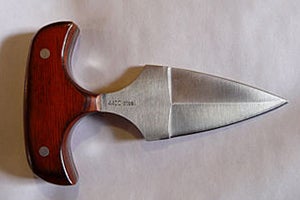
Under California law, a "dirk or dagger" is broadly defined to include any fixed-blade knife, dagger, or folding knife locked in an open position that is capable of immediate use as a deadly stabbing instrument.
Because weapons charges are strictly enforced across California municipal courts, prosecutors aggressive pursue PC 21310 violations whenever a covered blade is hidden from ordinary observation inside a pocket, waistband, or bag.
Charged as a "wobbler," a conviction can trigger up to three years in county jail, heavy fines, and a lasting criminal record—even if you had no intention of using the knife as a weapon.
Legal Definition: PC 21310
“Any person in this state who carries concealed upon his or her person any dirk or dagger is punishable by imprisonment in a county jail not exceeding one year or pursuant to subdivision (h) of Section 1170.” — California Penal Code § 21310 PC
Key Statutory Definitions
To secure a conviction under PC 21310, law enforcement and prosecutors rely on statutory definitions set forth in Penal Code § 16470 PC:
-
Dirk or Dagger (PC 16470): Defined as “a knife or other instrument with or without a handguard that is capable of ready use as a stabbing weapon that may inflict great bodily injury or death.” This includes fixed-blade knives, daggers, chef knives, ice picks, and folding pocketknives whose blades are locked in an open position.
-
Substantially Concealed: A weapon is concealed if it is hidden from ordinary observation, even partially, inside a pocket, jacket, waistband, purse, or backpack worn by the person.
-
Open Carry Exemption (PC 20200): A dirk or dagger carried in a sheath suspended from the waist is considered exposed and not concealed, making open belt carry lawful under California state law.
-
Exempted Folding Knives: Standard pocketknives, folding knives, or utility knives are not dirks or daggers unless the blade is locked open or fixed in a position capable of immediate stabbing.
Key Legal Elements vs. Defenses at a Glance
|
Factor |
Statutory Requirement / Prosecution Burden |
Valid Legal Defense Strategy |
| Concealment | Weapon was substantially concealed on the person. | Weapon was carried openly in a sheath suspended from the waist (PC 20200). |
| Readiness for Stabbing | Blade was fixed, locked open, or immediately usable to stab. | Folding knife was closed, folded, or unlocked in a pocket. |
| Knowledge (Mens Rea) | Defendant knew they carried the item and knew it was a stabbing tool. | Lack of knowledge (item planted, or placed in coat/bag by someone else). |
| Police Conduct | Weapon obtained via a lawful stop, pat-down, or search. | Suppression of evidence (PC 1538.5) due to illegal search or lack of probable cause. |
| Intent to Harm | NOT required to prove intent to use as a weapon. | Lack of intent does not defeat the charge, but avoids aggravated felony filing. |
What Must Be Proven to Convict (CALCRIM No. 2501)
Under Judicial Council of California Criminal Jury Instructions (CALCRIM No. 2501), the prosecution must prove the following three elements beyond a reasonable doubt:
-
The defendant carried a dirk or dagger concealed upon their person.
-
The defendant knew they were carrying the knife or instrument.
-
The defendant knew the knife or instrument could be used immediately as a stabbing weapon.
Note: The prosecution is NOT required to prove that you intended to use the dirk or dagger to harm or stab anyone.
Penalties for Penal Code § 21310 PC
Carrying a concealed dirk or dagger is a wobbler in California, meaning prosecutors can charge it as a misdemeanor or a felony based on criminal background and case facts.
Misdemeanor Penalties
-
County Jail: Up to 1 year in county jail.
-
Court Fines: Up to $1,000 plus penalty assessments.
-
Probation: Up to 1 to 3 years of summary (informal) probation.
Felony Penalties
-
County Jail / State Prison: 16 months, 2 years, or 3 years in county jail under California's realignment scheme.
-
Court Fines: Up to $10,000 plus penalty assessments.
-
Probation: Formal felony probation with regular probation officer reporting.
Aggravating Factors & Collateral Risks
-
Gang Activity or Violent Record: Prior violent convictions or gang enhancements heavily push prosecution toward felony filings.
-
Immigration Consequences: Carrying a concealed dirk or dagger combined with violent circumstances may be deemed a crime involving moral turpitude, leading to deportation or inadmissibility.
-
Record Reduction (PC 17b) & Expungement (PC 1203.4): Felony convictions can often be reduced to misdemeanors under PC 17(b) upon successful completion of probation, and misdemeanor convictions remain eligible for expungement under PC 1203.4.
Possible Defense Strategies
An experienced criminal defense attorney at the Esfandi Law Group can raise several key defenses against PC 21310 charges:
-
The Knife Was Not Concealed: Demonstrating that the knife was carried openly in a waist sheath or was plainly visible to an ordinary observer.
-
The Knife Was Folded / Not Ready to Stab: Proving the knife was a folding pocketknife with the blade safely stored inside the handle, meaning it was not "immediately usable as a stabbing weapon."
-
Lack of Knowledge: Establishing that you were unaware of the weapon's presence (e.g., carrying someone else's bag or wearing a jacket holding a knife you did not put there).
-
Illegal Search and Seizure (Fourth Amendment Violation): Filing a Motion to Suppress Evidence under Penal Code § 1538.5 PC if law enforcement conducted an unlawful pat-down or search without reasonable suspicion or probable cause.
Case Examples
-
Concealed Fixed Blade in Coat: An individual walks in public with a 4-inch fixed-blade hunting knife tucked entirely inside an inner jacket pocket during a police encounter.
-
Folded Pocketknife (Non-Violation): A person carries a folding utility knife inside their pants pocket with the blade closed, which does not meet the legal criteria of a dirk or dagger.
-
Lawful Open Belt Carry (Non-Violation): A hiker walks through a public park carrying a fixed-blade dagger secured safely in a sheath attached directly to their belt loop.
Related CA Laws
Understanding related weapons statutes is critical because prosecutors frequently stack or reduce charges based on how a weapon was carried, displayed, or used.
California Penal Code § 417 PC – Brandishing a Weapon: Prohibits drawing, exhibiting, or displaying any deadly weapon in a rude, angry, or threatening manner in another person's presence.
California Penal Code § 245(a)(1) PC – Assault with a Deadly Weapon: Makes it a serious felony to commit an assault upon another person using a deadly weapon other than a firearm, such as a dirk or dagger.
California Penal Code § 20200 PC – Open Carry of a Dirk or Dagger: Establishes that carrying a dirk or dagger in a sheath worn exposed and suspended from the waist is legal and exempt from PC 21310 concealment laws.
California Penal Code § 16590 PC – Possession of Prohibited Weapons: Covers general prohibitions on manufacturing, importing, or possessing illegal weapons like brass knuckles, ballistic knives, and cane swords.
California Penal Code § 171b PC – Weapons in Public Buildings: Bans bringing or possessing fixed-blade knives with blades over 4 inches into state or local public government buildings.
California Penal Code § 626.10 PC – Weapons on School Grounds: Makes it an offense to bring folding knives with locking blades, fixed-blade knives, or dirks/daggers onto K-12 school or university campuses.
Frequently Asked Questions (FAQs)
Is carrying a concealed pocketknife illegal under PC 21310 in California?
No, carrying a closed pocketknife in your pocket is generally legal. A pocketknife only becomes an illegal concealed dirk or dagger if the blade is locked open or fixed in a position ready for immediate stabbing.
Can I legally carry a dirk or dagger openly on my belt?
Yes. Under California Penal Code § 20200 PC, carrying a dirk or dagger in a sheath that is exposed and suspended from your waist is explicitly legal and does not constitute illegal concealed carry.
Is carrying a concealed dirk or dagger a felony or a misdemeanor?
PC 21310 is a "wobbler" offense. Misdemeanor convictions carry up to 1 year in county jail and $1,000 in fines, while felony convictions carry up to 3 years in county jail and up to $10,000 in fines.
Do prosecutors have to prove I intended to use the dagger as a weapon?
No. Prosecutors only need to prove that you knowingly possessed the item, knew it was concealed, and knew it was capable of immediate use as a stabbing weapon. Intent to harm or use it aggressively is not required.
Can a felony conviction under PC 21310 be reduced to a misdemeanor later?
Yes. If granted probation on a felony wobbler conviction under PC 21310, you can petition the court to reduce the offense to a misdemeanor under California Penal Code § 17(b) PC upon successful completion of probation terms.