
Penal Code § 21510 PC – Possession of a Switchblade Knife
California Penal Code § 21510 PC strictly prohibits switchblade knives in California, making it illegal to carry, possess in a vehicle, sell, loan, or transfer any automatic knife with a blade measuring two inches or longer.
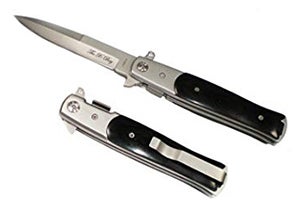
California enforces a zero-tolerance policy for carrying long-bladed automatic knives in public settings. Unlike many weapons offenses, prosecutors are not required to prove that you intended to use the knife as a threat or weapon.
Simply having a qualifying switchblade in your pocket, backpack, or vehicle's driver area can result in an immediate misdemeanor arrest, up to six months in county jail, and a lasting criminal record.
Legal Definition: PC 21510
“Every person who does any of the following with a switchblade knife having a blade two or more inches in length is guilty of a misdemeanor:
(a) Carries the knife upon their person.
(b) Carries the knife within the driver's area of any motor vehicle in any public place or place open to the public.
(c) Sells, offers for sale, exposes for sale, loans, transfers, or gives the knife to any other person.” — California Penal Code § 21510 PC
Key Statutory Definitions
To convict an individual under PC 21510, prosecutors must establish that the knife meets specific legal criteria under California law:
-
Switchblade Knife (PC 17235): Defined as “a knife with the appearance of a pocketknife and includes a spring-blade knife, snap-blade knife, gravity knife, or similar type knife, the blade of which is two or more inches and can be released automatically by a flick of a button, pressure on the handle, flip of the wrist or other mechanical device, or released by the weight of the blade.” This definition includes butterfly knives (balisongs). It excludes thumb-stud, bias-toward-closure folding pocketknives unless the blade opens automatically.
-
Driver's Area of a Vehicle: Covers the entire open passenger compartment accessible to the driver, including the glove compartment, center console, dashboard, or under the driver's seat in a vehicle located in a public area.
-
Carries Upon Their Person: Having direct physical control over the knife, such as carrying it in a hand, pocket, waistband, purse, or backpack worn by or attached to the individual.
Key Legal Elements vs. Defenses at a Glance
|
Factor |
Statutory Requirement / Prosecution Burden |
Valid Legal Defense Strategy |
| Blade Length | Blade measures 2.0 inches or longer. | Blade measures under 2.0 inches ( tip-to-bolster measurement). |
| Opening Mechanism | Deploys automatically via button, lever, gravity, or wrist flick. | Manual opening with thumb-stud and internal spring bias-to-close. |
| Knowledge (Mens Rea) | Defendant knew they had the knife and knew it was a switchblade. | Lack of knowledge (knife left in borrowed coat or vehicle). |
| Location / Action | Carried on person, in driver area in public, or offered for sale. | Lawful private location; or evidence seized via unconstitutional stop. |
| Intent to Use | NOT required to prove intent to use as a weapon. | Lack of intent does not defeat charge, but avoids aggravated sentencing. |
What Must Be Proven to Convict (CALCRIM No. 2502)
Under Judicial Council of California Criminal Jury Instructions (CALCRIM No. 2502), the prosecution must prove the following elements beyond a reasonable doubt:
-
The defendant carried a switchblade knife on their person, carried it in the driver's area of a motor vehicle in a public place, or sold/transferred/loaned it.
-
The knife had a blade two inches or longer.
-
The defendant knew they were carrying or possessing the knife.
-
The defendant knew the knife had the characteristics of a switchblade.
Note: Prosecutors are NOT required to prove you intended to use the switchblade as a weapon.
Penalties for Penal Code § 21510 PC
California Penal Code § 21510 PC is charged strictly as a misdemeanor criminal offense. While many first-time offenses result in probation rather than incarceration, a conviction carries mandatory statutory consequences and a permanent criminal record.
Statutory Maximum Penalties
-
County Jail: Up to 6 months in county jail.
-
Court Fines: Up to $1,000 in base fines, plus state and local court penalty assessments.
-
Weapon Forfeiture: Automatic confiscation and destruction of the switchblade by law enforcement.
Summary (Informal) Probation
Instead of serving jail time, a judge may sentence a defendant to 1 to 3 years of summary probation. Standard probation conditions under PC 21510 typically include:
-
Mandatory compliance with all local, state, and federal laws.
-
Completion of community service or roadside labor (Caltrans).
-
Restitution or court-ordered counseling programs (if applicable).
-
Submission to search and seizure conditions.
Aggravating Factors That Increase Jail Risk
Although judges frequently grant probation for standalone switchblade charges, specific aggravating circumstances significantly increase the likelihood of actual jail time:
-
Prior Criminal Record: Previous felony convictions or prior weapons-related violations.
-
History of Violence: Past arrests or convictions involving violent behavior.
-
Gang Enhancements: Active gang involvement or carrying the weapon in furtherance of gang activity.
-
Uncooperative Arrest: Resisting, obstructing, or fleeing from law enforcement during the search or stop.
-
Implied Weapon Intent: Evidence suggesting an intent to use the switchblade aggressively, even though intent is not required to establish guilt.
Collateral Consequences & Record Relief
-
Immigration Status: While a simple misdemeanor knife charge is not typically an aggravated felony under federal immigration law, any conviction tied to violent intent or weapon enhancements can trigger scrutiny regarding moral turpitude or inadmissibility.
-
Expungement (PC 1203.4): After completing probation or jail terms—provided there are no pending charges—the conviction can be expunged under Penal Code § 1203.4 PC, releasing the individual from most negative collateral effects of a misdemeanor record.
What are the Defense Strategies?
An experienced criminal defense attorney at the Esfandi Law Group can utilize several legal strategies to fight PC 21510 charges:
-
Blade Length Under 2 Inches: Measuring the blade precisely from tip to bolster; if the cutting edge/blade is under 2.0 inches, it falls outside the statute.
-
Not a Statutory Switchblade (Bias-to-Close Defense): Proving the knife is a manual-opening pocketknife, thumb-stud folder, or assisted-opener designed with a mechanism that bias-resists opening.
-
Lack of Knowledge: Demonstrating that you were unaware of the knife's presence (e.g., a borrowed jacket or vehicle containing a switchblade placed by someone else).
-
Unlawful Search and Seizure (Fourth Amendment Violation): Filing a Motion to Suppress Evidence under PC 1538.5 if police discovered the knife during an unconstitutional stop, frisk, or vehicle search without probable cause.
Case Examples
-
Vehicle Search in a Public Lot: Police conduct a traffic stop in a public parking lot and discover a 3-inch automatic spring-assisted knife inside the driver's center console.
-
Lack of Knowledge in Borrowed Clothing: An individual borrows a friend's coat for the evening, unaware that a 2.5-inch butterfly knife is tucked into an inside chest pocket.
-
Non-Qualifying Pocketknife: An owner carries a standard folding pocketknife with a thumb stud that requires manual force to deploy, which law enforcement mistakenly misidentifies as a gravity knife.
Related CA Laws
Reviewing related knife and weapons statutes is critical because law enforcement officers and prosecutors routinely stack or substitute charges based on how a knife was carried or displayed.
California Penal Code § 21310 PC – Carrying a Concealed Dirk or Dagger: Makes it a wobbler offense (felony or misdemeanor) to carry any concealed fixed-blade knife or stabbing instrument capable of causing great bodily injury.
California Penal Code § 417 PC – Brandishing a Weapon: Prohibits drawing, exhibiting, or displaying any deadly weapon in a rude, angry, or threatening manner in the presence of another person.
California Penal Code § 20200 PC – Open Carry of a Dirk or Dagger: Establishes that carrying a dirk or dagger in a sheath worn openly suspended from the waist is lawful and does not constitute concealed carry.
California Penal Code § 626.10(a)(1) PC – Weapons on School Grounds: Makes it a public offense to bring or possess any folding knife with a locking blade, fixed blade knife, or switchblade onto public or private K-12 school grounds.
Frequently Asked Questions (FAQs)
Is a butterfly knife (balisong) illegal under PC 21510 in California?
Yes. California courts explicitly classify butterfly knives and fan knives as switchblades under Penal Code § 17235 PC if the blade measures 2 inches or longer.
Can I carry a switchblade if the blade is less than 2 inches long?
Yes. Switchblade knives with blades under 2 inches (such as small automatic pocketknives) are exempt from PC 21510 restrictions, as long as they don't violate other local ordinances or school ground rules.
Is carrying a concealed switchblade a felony in California?
No. A violation of PC 21510 is strictly a misdemeanor, punishable by up to 6 months in county jail. However, if the switchblade is locked in an open position and carried concealed, prosecutors might charge carrying a concealed dirk or dagger under PC 21310, which can be filed as a felony.
Can I possess a switchblade in my own private home?
While PC 21510(b) specifically restricts vehicles in public places and PC 21510(a) restricts carrying on your person, the statute also bans selling, loaning, or transferring switchblades. Simple private home possession of long-blade switchblades can still trigger legal issues if you transfer them or carry them outside.
Can a conviction for PC 21510 affect my immigration status?
Generally, a standalone misdemeanor conviction under PC 21510 is not classified as an aggravated felony. However, if tied to violent conduct or weapon enhancements, any criminal charge can raise complications regarding moral turpitude or visa adjustments, making consultation with an immigration attorney essential.
The Esfandi Law Group in Los Angeles can help you. Schedule your free consultation at (310) 274-6529 or use the contact form.