
California Penal Code § 247(b) PC: Shooting at an Unoccupied Motor Vehicle or Uninhabited Structure
Under Penal Code § 247(b) PC, it is a serious criminal offense to discharge a firearm at an unoccupied motor vehicle, an uninhabited building, or an uninhabited dwelling house without the owner's consent.
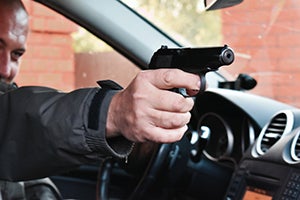
While Penal Code § 246 PC addresses shooting at inhabited dwellings or occupied vehicles (a straight violent felony), PC 247(b) PC targets property destruction and dangerous weapon discharges involving vacant or unoccupied structures.
Because California maintains some of the nation's strictest firearm laws, a PC 247(b) conviction can result in state prison time, significant financial penalties, and a loss of firearm ownership rights.
Statutory Definition (Legal Text)
California Penal Code Section 247(b) PC states:
"Any person who discharges a firearm at an unoccupied motor vehicle or an uninhabited building or dwelling house is guilty of a public offense punishable by imprisonment in the county jail for not more than one year or in the state prison. This subdivision does not apply to discharging a firearm at an abandoned vehicle, unoccupied vehicle, uninhabited building, or dwelling house with the permission of the owner."
Key Statutory Definitions
To secure a conviction under Penal Code § 247(b) PC, courts and jury instructions (CALCRIM 966) rely on precise legal definitions:
-
Uninhabited Dwelling or House: A home, apartment, or residential structure that is currently not being used for dwelling purposes—meaning no one lives there or uses it as a residence. Under California law, if a home is actively lived in but the residents are temporarily away, it remains legally "inhabited," elevating the charge to Penal Code § 246 PC. A dwelling is only "uninhabited" if former residents have moved out with no intent to return, or if it is entirely vacant.
-
Unoccupied Building or Vehicle: A commercial structure, office, barn, motor vehicle, or aircraft that has no human being physically present inside at the exact moment the firearm is discharged.
-
Willful Act: Firing a weapon intentionally or on purpose. It does not require an intent to break the law, injure someone, or cause damage, only that the act of pulling the trigger was non-accidental.
-
Owner Consent: Explicit authorization or permission granted by the legal owner of the property, building, or vehicle to shoot at the target. Proof of owner consent serves as a full statutory defense to charges under PC 247(b).
-
Firearm: Any device designed to be used as a weapon from which a projectile is discharged or expelled through a barrel by the force of an explosion or other form of combustion (e.g., handguns, rifles, shotguns).
What Must Be Proven to Convict
To secure a conviction under PC 247(b) PC, prosecutors must establish three legal elements beyond a reasonable doubt:
-
Discharge of a Firearm: The defendant willfully and unlawfully discharged a firearm (a device designed as a weapon where a projectile is expelled through a barrel by the force of an explosion or combustion).
-
Targeted Unoccupied Target: The firearm was discharged directly at—or in close proximity to—an unoccupied motor vehicle, an uninhabited building, or an uninhabited dwelling house.
-
Lack of Owner Consent: The defendant did not have express permission from the owner of the vehicle, building, or property to shoot at the target.
Penalties for Penal Code § 247(b) PC
Shooting at an unoccupied vehicle or building under PC 247(b) PC is a "wobbler" offense in California, meaning prosecutors have discretion to file charges as either a misdemeanor or a felony based on the case facts and the defendant's criminal record.
-
Misdemeanor Penalties:
-
Up to 1 year in county jail.
-
Summary (informal) probation.
-
Criminal fines up to $1,000.
-
A 10-year or lifetime prohibition on firearm ownership under California law.
-
-
Felony Penalties:
-
16 months, 2 years, or 3 years in state prison (served in county jail pursuant to PC 1170(h)).
-
Formal felony probation.
-
Criminal fines up to $10,000.
-
Permanent lifetime ban on buying, owning, or possessing firearms under PC 29800.
-
Common Legal Defenses to PC 247(b)
Defending against a Penal Code 247(b) PC charge requires challenging the prosecution's evidence regarding intent, authorization, target status, and identification. Strategic defense approaches include:
-
Property Owner's Express Consent:
The statutory language of PC 247(b) PC explicitly provides an exception for individuals who have permission from the owner of the vehicle, building, or property. If defense counsel can present documentation, communication records, or witness testimony demonstrating that you had valid authorization to shoot at the structure or vehicle (e.g., target shooting on private property or destroying an old vehicle on a private ranch), you cannot be convicted under this statute.
-
Accidental Discharge / Lack of Willful Intent:
To secure a conviction, the prosecution must prove beyond a reasonable doubt that you acted willfully and maliciously when discharging the firearm. If the weapon discharged accidentally due to a mechanical malfunction, drop hazard, mishandling slip, or misfire while clearing a jam, the required criminal mental state (mens rea) is absent, defeating the PC 247(b) charge.
-
Target Was Abandoned or Permitted Target Shooting Location:
If the vehicle or structure was legally classified as abandoned on public property designated for recreational target shooting, or if you were firing at targets set up on approved shooting ranges, PC 247(b) PC does not apply. Defense counsel can establish the physical location and legal status of the land to dismantle the prosecution's allegations.
-
Mistaken Identity and Unreliable Eyewitnesses:
Shooting allegations frequently rely on hurried eyewitness accounts, vague physical descriptions, or loud noise reports in rural or isolated areas. Defense attorneys utilize forensic ballistics audits, phone GPS location records, surveillance footage, and cross-examination to expose doubts regarding who actually fired the weapon or whether you were present at the scene.
-
Self-Defense or Defense of Others:
Even when firing toward an unoccupied structure or vehicle, you are legally justified under California law if you discharged the firearm out of a reasonable belief that you or another person faced an imminent threat of severe bodily injury or death, and shooting was necessary to deter or stop that danger.
Hypothetical Examples
-
Felony PC 247(b) Example: An individual gets angry at an ex-employer after business hours and fires several rounds into the front door of the closed, empty office building. Because the building was unoccupied and lacked owner consent, the shooter faces PC 247(b) charges.
-
Target Practice / Valid Defense Example: A landowner invites a friend to bring a newly purchased rifle to a rural ranch to shoot at an old, unregistered tractor parked in a field. Because the act was performed on private property with explicit owner permission, PC 247(b) does not apply.
-
Elevated Charge (PC 246) Example: A suspect fires shots at an apparently dark, quiet house, assuming no one is inside. However, the house is actively rented and lived in by a family away on vacation. Because the residence is legally "inhabited," the crime escalates to PC 246 PC (a serious violent felony).
Frequently Asked Questions (FAQs)
Is Penal Code § 247(b) PC a felony or a misdemeanor?
PC 247(b) PC is a "wobbler" offense in California. Prosecutors can charge it as either a misdemeanor (carrying up to 1 year in jail) or a felony (carrying up to 3 years in state prison), depending on the case details and your criminal background.
What is the difference between Penal Code 246 PC and Penal Code 247(b) PC?
PC 246 PC covers shooting at inhabited dwellings or occupied vehicles (a straight violent felony with up to 7 years in prison and a Three Strikes designation). PC 247(b) PC covers shooting at unoccupied vehicles or uninhabited buildings (a wobbler with up to 3 years in prison).
Can you shoot at your own car or building under PC 247(b)?
No, provided you are the sole legal owner and doing so does not violate other firearm regulations (such as reckless discharge under PC 246.3 or local ordinance bans on firing weapons within city limits). PC 247(b) specifically penalizes shooting targets without owner permission.
Can a felony PC 247(b) charge be reduced to a misdemeanor?
Yes. Because PC 247(b) PC is a wobbler, an experienced criminal defense attorney can negotiate with prosecutors or petition the court under PC 17(b) to reduce a felony charge to a misdemeanor.
What happens if I accidentally shot an unoccupied car while cleaning my gun?
If the firearm discharged purely by accident without willful or reckless intent, you lack the required mental state for PC 247(b) PC. However, prosecutors might evaluate whether the conduct constitutes negligent discharge under PC 246.3 PC.
Is PC 247(b) PC considered a strike under California's Three Strikes Law?
No. Unlike PC 246 PC, a conviction under PC 247(b) PC is not automatically classified as a violent felony or a "strike" under California Penal Code § 667.5(c) PC.
What if the building was empty, but an unhoused person was sleeping inside?
If someone was physically inside the building at the time of the shooting, the building was legally "occupied." This elevates the charge from PC 247(b) PC to PC 246 PC, which carries much harsher prison sentences.
Will I lose my right to own firearms if convicted under PC 247(b) PC?
Yes. A felony conviction under PC 247(b) PC triggers a lifetime ban on owning or possessing firearms in California. A misdemeanor conviction results in a 10-year prohibition.
Related California Laws
Reviewing related statutes provides crucial legal context, showing how prosecutors build complex multi-charge cases and revealing alternative, reduced offenses that criminal defense attorneys can leverage during negotiations.
-
Penal Code 246 PC – Shooting at an Inhabited Dwelling or Occupied Vehicle: Prohibits maliciously discharging a firearm at any residence currently used for living purposes or any occupied building, vehicle, or camper. A straight violent felony carrying 3, 5, or 7 years in state prison and an automatic "strike" under California's Three Strikes Law.
-
Penal Code 246.3 PC – Grossly Negligent Discharge of a Firearm: Criminalizes discharging a firearm in a grossly negligent manner that could result in injury or death to a person, regardless of whether a building or vehicle was targeted. A "wobbler" punishable as a misdemeanor or felony carrying up to 3 years in state prison.
-
Penal Code 417 PC – Brandishing a Weapon or Firearm: Prohibits drawing, exhibiting, or displaying a firearm or deadly weapon in a rude, angry, or threatening manner during an altercation. Typically a misdemeanor carrying up to 6 months or 1 year in county jail.
-
Penal Code 594 PC – Vandalism: Criminalizes maliciously defacing, damaging, or destroying another person's real or personal property. Punishable as a misdemeanor or felony depending on the monetary damage, carrying up to 3 years in custody.
-
Penal Code 245(a)(2) PC – Assault with a Firearm: Prohibits unlawfully attempting to commit a violent injury on another person using a firearm while possessing the present ability to do so. A "wobbler" punishable as a misdemeanor or felony carrying 2, 3, or 4 years in state prison.
-
Penal Code 29800 PC – Felon in Possession of a Firearm: Prohibits any person previously convicted of a felony (or specific violent misdemeanors) from purchasing, owning, receiving, or possessing any firearm. A felony carries 16 months, 2 years, or 3 years in state prison.
Why Related Laws Matter
Reviewing related statutes provides crucial legal context, showing how prosecutors build complex multi-charge cases and revealing alternative, reduced offenses that criminal defense attorneys can leverage during negotiations.
Because weapon offenses in California often carry severe custody terms and firearm prohibitions, identifying weaknesses in the prosecution's case—such as establishing consent, proving the target was completely uninhabited, or demonstrating an accidental discharge—enables defense attorneys to negotiate felony charges down to misdemeanors like PC 594 vandalism or secure a full case dismissal.
The best way to achieve a favorable result is to speak with an experienced criminal defense attorney at Esfandi Law Group in California. Call us for a free consultation at (310) 274-6529 or fill out the contact form.