
While California state law does not feature a single standalone statute explicitly titled "public urination," the act is illegal across the state.
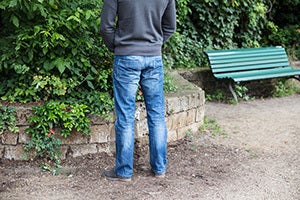
Law enforcement agencies and prosecutors penalize public urination using a combination of California Penal Code statutes and local municipal codes.
Depending on factors such as location, state of sobriety, level of exposure, and alleged intent, public urination can be charged as a minor municipal infraction carrying a fine, a misdemeanor public nuisance, or—in extreme cases—a severe sex offense such as indecent exposure.
Simply put, although there is no single "public urination" state statute, California police officers routinely issue citations or make arrests under local city ordinances, Penal Code 372 (Public Nuisance), Penal Code 647(f) (Public Intoxication), Penal Code 640 (Transit Violations), or Penal Code 314 (Indecent Exposure).
While most first-time incidents are handled as infractions resulting in a fine, aggravating circumstances can lead to misdemeanor criminal charges, potential jail time, and a permanent criminal record.
Penalties and Classifications for Public Urination in California
Because public urination is prosecuted under various state statutes and municipal codes, penalties depend heavily on how prosecutor agencies classify the offense.
-
Local Municipal Ordinances (City Codes): Charged as an infraction or misdemeanor depending on local municipal law (e.g., Los Angeles Municipal Code 41.47.2). Penalties range from fines of $100 to $500 for infractions, up to $1,000 in fines, community service, or up to 6 months in county jail if filed as a misdemeanor.
-
Penal Code 372 (PC 372) – Public Nuisance: Charged as a misdemeanor when the act is deemed harmful to public health, offensive to the senses, or disruptive to community comfort. Penalties include up to 6 months in county jail, summary probation, and fines up to $1,000.
-
Penal Code 647(f) (PC 647(f)) – Public Intoxication: Charged as a misdemeanor if the person is intoxicated by alcohol or drugs in a public place and unable to care for their own safety or blocking a public way. Penalties include up to 6 months in county jail and fines up to $1,000.
-
Penal Code 640 (PC 640) – Public Transportation Offenses: Charged as an infraction or misdemeanor for urinating in a transit facility or vehicle (buses, trains, subways) outside designated restrooms. Penalties include fines up to $400, community service, or up to 90 days in county jail.
-
Penal Code 314 (PC 314) – Indecent Exposure: Charged as a misdemeanor (or felony for repeat offenders) if prosecutors allege the person exposed their genitals with the intent to offend or for sexual arousal. Penalties include up to 6 months in jail (misdemeanor) or up to 3 years in state prison (felony), plus mandatory lifetime sex offender registration under Penal Code 290.
-
Penal Code 647(a) (PC 647(a)) – Lewd Conduct in Public: Charged as a misdemeanor if the conduct is interpreted as lewd or offensive in a public place. Penalties include up to 6 months in jail, fines up to $1,000, and potential sex offender registration.
Common Legal Defenses Against Public Urination Charges
A skilled California criminal defense attorney can utilize several legal defenses to dismiss or reduce public urination charges depending on the statutory offense filed:
-
Lack of Lewd or Sexual Intent: Crucial for defending against PC 314 (Indecent Exposure) or PC 647(a) (Lewd Conduct). Demonstrating that the act was purely an act of physiological necessity with zero sexual motivation or intent to offend forces the prosecution to drop sex-related charges.
-
Medical Condition or Involuntary Necessity: Establishing that a diagnosed medical condition (e.g., severe UTI, incontinence, prostate issues, or Crohn's disease) caused a sudden, uncontrollable emergency where no public restroom was accessible.
-
Insufficient Evidence or Mistaken Identity: Challenging police claims by proving a lack of photographic proof, lack of independent witnesses, or misidentification in crowded dark areas or nightlife districts.
-
Unlawful Search, Seizure, or Detention: Filing a motion to suppress evidence under Penal Code 1538.5 if officers lacked reasonable suspicion to detain or search you prior to issuing a citation.
Hypothetical Case Examples
-
Local Ordinance Infraction: An individual discreetly urinates behind a dumpster in an alley late at night after finding nearby business restrooms locked. Officers issue an administrative citation under the local city code, resulting in a minor $100 fine with no criminal record.
-
Public Intoxication Misdemeanor (PC 647(f)): A patron leaves a bar heavily intoxicated, stumbles into a public park, and urinates on a walkway while slurring speech and failing to stand upright. Officers arrest the patron for misdemeanor public intoxication, carrying potential probation and fines.
-
Indecent Exposure Overturned (PC 314): A driver experiencing a severe gastrointestinal/bladder emergency pulls off the highway and urinates near a roadside barrier. Officers arrest the driver under PC 314 for indecent exposure. Defense counsel presents medical records and establishes lack of sexual intent, forcing the prosecutor to reduce the charge to a simple infraction.
Frequently Asked Questions (FAQs)
Can you go to jail for public urination in California?
Yes, if charged as a misdemeanor under Penal Code 372, Penal Code 647(f), or Penal Code 314. However, most first-time incidents without aggravating factors are resolved as municipal infractions with simple fines.
Is public urination automatically considered a sex crime in California?
No. Public urination is not inherently a sex crime unless prosecutors file charges under Penal Code 314 (Indecent Exposure), which requires proving you exposed yourself for sexual gratification or to affront/offend others.
Will a public urination citation show up on a background check?
If issued as an infraction under local municipal codes, it generally does not appear on standard criminal background checks. If prosecuted as a misdemeanor under the Penal Code, a conviction will appear on criminal history searches.
Can you fight a public urination ticket or misdemeanor charge in court?
Yes. A criminal defense attorney can challenge the prosecution by presenting medical necessity, lack of evidence, lack of sexual intent, or constitutional violations during the police encounter.
Do all cities in California enforce public urination the same way?
No. Enforcement varies significantly by city and county. Major municipalities like Los Angeles, San Francisco, and San Diego enforce strict municipal codes alongside state statutes.
What should you do if police cite or arrest you for public urination?
Do not make self-incriminating statements or admit to being intoxicated. Polite cooperation regarding identification is legally required, but you should speak with a criminal defense lawyer before giving detailed statements.
Can a public urination charge be expunged from your record in California?
Yes. If convicted of a misdemeanor public urination offense, you can petition the court for an expungement under Penal Code 1203.4 once you successfully complete probation.
Is lack of available public restrooms a valid legal defense?
While lack of restrooms alone is rarely an absolute legal defense to an infraction, it strongly supports a defense against misdemeanor public nuisance or indecent exposure charges by demonstrating lack of criminal intent.
The legal team at Esfandi Law Group possesses extensive experience protecting clients against public nuisance, disorderly conduct, and indecent exposure allegations across California courts.
Call (310) 274-6529 today or complete our online contact form to schedule your free, confidential case evaluation.
