
Fingerprint evidence has long been portrayed as infallible in criminal investigations. Law enforcement agencies, prosecutors, and juries often assume that every latent print left at a crime scene provides a definitive link to a suspect.
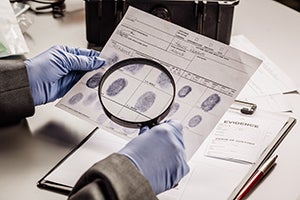
However, modern forensic research, scientific studies, and real-world exonerations demonstrate that fingerprint analysis is not an exact science.
Unlike biological DNA profiling, fingerprint identification relies heavily on human visual judgment, subjective pattern interpretation, and unstandardized analysis protocols. Environmental factors, distorted prints, and cognitive bias can result in false matches and wrongful convictions.
If you or a loved one is facing criminal charges based on latent print findings, fighting the prosecution's forensic evidence is critical. The Esfandi Law Group provides strategic, aggressive criminal defense throughout California.
Flaws and Limitations: Fingerprint Evidence vs. DNA Evidence
When evaluating forensic reliability in California criminal trials, comparing fingerprint analysis to DNA evidence highlights critical differences in scientific validity, methodology, and objectivity:
-
Primary Basis of Analysis: DNA testing relies on the objective genetic profiling of biological material, whereas fingerprint evidence relies on subjective pattern matching of friction ridge details (such as loops, whorls, and arches).
-
Level of Standardization: DNA analysis follows strictly standardized national laboratory protocols with universally enforced benchmarks. Conversely, fingerprint analysis lacks universally mandated point-matching thresholds across state and national jurisdictions.
-
Methodological Objectivity: DNA testing produces highly objective results driven by statistical laboratory calculations. In contrast, fingerprint identification remains partially subjective, relying heavily on human visual perception and individual examiner judgment.
-
Scientific Error Rates: DNA profiling carries an extremely low error rate when samples are properly collected and processed. Fingerprint analysis carries a significantly higher potential for human error, particularly when dealing with partial, faint, or smudged latent prints.
-
Quality and Sample Requirements: While DNA can be successfully amplified from minute biological traces like blood, saliva, or skin cells, latent fingerprints are highly vulnerable to surface texture, pressure distortion, sweat degradation, and environmental smudging.
-
Consistency Among Experts: Qualified DNA laboratories routinely replicate identical results from the same sample. By contrast, fingerprint examiners analyzing the exact same latent print frequently reach conflicting conclusions regarding whether a match exists.
-
Susceptibility to Cognitive Bias: DNA processing utilizes automated, blind sample procedures that minimize bias. Fingerprint analysts are highly susceptible to contextual bias, especially when exposed to investigative details, police expectations, or suspect confessions.
-
Database Processing Procedures: The Combined DNA Index System (CODIS) yields direct statistical probabilities for matching profiles. The Automated Fingerprint Identification System (AFIS) only generates a list of candidate matches, leaving the final, subjective decision entirely to a human examiner.
-
False Positive Potential: False positives in DNA profiling are exceedingly rare without direct physical or laboratory contamination. In fingerprint analysis, false positive identifications present a documented risk when examining low-quality or incomplete prints.
-
Admissibility and Evidentiary Challenges: DNA evidence is challenged primarily on chain-of-custody or sample contamination grounds. Fingerprint testimony is increasingly subject to aggressive pre-trial exclusion motions under Sargon and Kelly-Frye standards due to its inherent subjectivity.
Why Fingerprint Evidence Can Be Unreliable in Court
Although widely used by law enforcement, fingerprint identification is subject to critical scientific limitations that can compromise its accuracy:
-
Lack of Uniform Point-Match Standards: California and federal courts do not enforce a fixed, minimum number of matching friction ridge points required to declare a definitive match, leading to inconsistent evaluations among examiners.
-
Subjectivity in the ACE-V Process: Fingerprint analysts follow the Analysis, Comparison, Evaluation, and Verification (ACE-V) method, but because every phase relies on human visual perception, two trained examiners analyzing the exact same latent print can reach contradictory conclusions.
-
Cognitive and Contextual Bias: Examiners who are provided with investigative details—such as knowing a suspect confessed or was identified by an eyewitness—are statistically more likely to interpret ambiguous or distorted ridge details as a match.
-
Latent Print Degradation and Distortion: Crime scene prints are rarely clean, fully pressed impressions; they are typically partial, smudged, or distorted by surface texture, extreme temperatures, moisture, or overlapping prints.
-
Database Limitations (AFIS): Automated Fingerprint Identification Systems only generate a list of candidate prints based on algorithms. The final determination relies entirely on human interpretation, where misidentifications frequently occur.
Hypothetical Examples
-
Partial Print Disagreement (Subjective Examiner Variance): A partial, smudged print is lifted from a residential window following a burglary. The prosecution's analyst asserts a positive match with the defendant, but a court-appointed defense forensic expert demonstrates that key ridge details were distorted by surface dust, making a conclusive match scientifically impossible.
-
Contextual Bias in High-Pressure Cases (Cognitive Bias): Investigators inform a forensic analyst that a suspect's vehicle was spotted near a robbery scene. Influenced by this context, the analyst interprets a faint, partial latent print on a store counter as a match, failing to note three clear ridge discrepancies that later exonerate the defendant.
-
Secondary Transfer and Privacy Issues (Legitimate Presence): A defendant's fingerprint is lawfully identified on a mobile phone recovered at a crime scene. Defense counsel presents evidence that the defendant handled the phone hours earlier at a legitimate business meeting, proving that the physical presence of a print does not establish participation in a subsequent crime.
Related Laws and Legal Standards in California
Challenging forensic evidence in California courts involves specific statutory rules, evidentiary standards, and constitutional mandates:
-
California Evidence Code § 801 (Expert Testimony Standards): Limits expert opinion testimony to subjects sufficiently beyond common experience and requires that opinions be based on reliable, scientifically sound methodologies.
-
California Evidence Code § 352 (Exclusion of Prejudicial Evidence): Grants judges the discretion to exclude forensic evidence if its persuasive weight is substantially outweighed by the probability of misleading the jury or creating undue prejudice.
-
California Penal Code § 1473 (Habeas Corpus & Wrongful Convictions): Permits individuals to challenge a criminal conviction if new scientific evidence emerges or if previously introduced forensic evidence (such as flawed fingerprint analysis) is discredited.
-
The Kelly-Frye / Sargon Evidentiary Standards: California legal precedents requiring trial courts to act as gatekeepers, excluding expert testimony that relies on speculative logic or unproven scientific techniques.
-
Brady v. Maryland (Constitutional Disclosure Requirements): Mandates that prosecutors disclose all exculpatory evidence to the defense, including lab errors, conflicting expert reviews, or misconduct by forensic examiners.
Frequently Asked Questions (FAQs)
Are fingerprints completely unique to every individual?
While friction ridge patterns are widely considered unique, no comprehensive scientific study has ever analyzed every human fingerprint. More importantly, a latent print recovered from a crime scene is almost always an incomplete, distorted fragment rather than a full, perfect impression.
Can two fingerprint experts look at the same print and disagree?
Yes. Because latent print comparison relies on visual interpretation rather than automated, objective mathematical metrics, qualified forensic examiners frequently reach conflicting conclusions regarding whether a print matches a suspect.
What is the difference between an inked booking print and a latent print?
An inked booking print is a complete, clear, and controlled impression taken under ideal conditions. A latent print is an invisible or faint residue of sweat and oil left at a crime scene, which is frequently smudged, partial, or distorted by the surface.
How do defense attorneys challenge fingerprint evidence in California?
Defense attorneys challenge fingerprint evidence by hiring independent forensic experts, requesting Kelly-Frye or Sargon hearings to evaluate the analyst's methodology, exposing cognitive bias, and demonstrating improper evidence collection or chain-of-custody errors.
What is AFIS and does an AFIS match prove guilt?
The Automated Fingerprint Identification System (AFIS) is a computer database that searches millions of records to generate a list of candidate prints. AFIS does not declare a match; a human examiner must visually evaluate the candidates, making the final result subject to human error.
Is fingerprint evidence as reliable as DNA evidence?
No. DNA testing relies on objective, standardized genetic and statistical analysis with near-zero error rates when properly handled. Fingerprint analysis relies heavily on subjective visual comparison by human examiners and lacks standardized statistical thresholds.
Can a fingerprint be placed on an object without the person committing a crime?
Yes. A person may have touched an object legitimately at an earlier time, or a print can be moved via "secondary transfer" (where skin oils carrying ridge impressions are transferred from one surface or person to another).
Can fingerprint evidence alone lead to a criminal conviction in California?
While prosecutors can introduce latent print matches as circumstantial evidence, defense attorneys can raise reasonable doubt by demonstrating print distortion, highlighting examiner bias, proving secondary transfer, or establishing an innocent explanation for why the print was present.
Potential Defense Strategies
Challenging forensic allegations requires technical knowledge, experienced expert witnesses, and meticulous legal analysis. The defense team at Esfandi Law Group protects clients facing charges involving questionable forensic evidence by:
-
Retaining Independent Forensic Experts: Partnering with former law enforcement print examiners to re-analyze latent prints, evaluate clarity, and expose analytical errors made by state technicians.
-
Filing Pre-Trial Motions to Exclude Evidence: Motioning under Evidence Code § 352 and Sargon guidelines to block unreliable, highly prejudicial, or speculative forensic testimony from being presented to the jury.
-
Exposing Cognitive and Investigator Bias: Cross-examining state crime lab analysts regarding their exposure to investigative bias, pressure from prosecutors, and failures to follow standardized double-blind verification protocols.
-
Establishing Lack of Temporal Relevance: Proving that even if a print belongs to the defendant, the prosecution cannot establish when or under what circumstances the impression was left.
Schedule a Free, Confidential Legal Consultation
Do not allow flawed forensic assumptions to jeopardize your freedom and future. Call Esfandi Law Group today at (310) 274-6529 or complete our online contact form to speak directly with an experienced California criminal defense lawyer.
