
Understanding your constitutional rights during a traffic stop is essential when law enforcement officers attempt to search your vehicle. Under both federal and state law, individuals are protected against unreasonable searches and seizures.
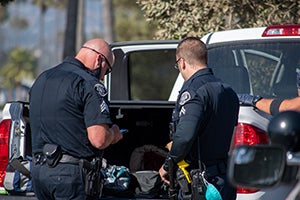
While police generally need a search warrant issued by a judge to inspect your vehicle, California law recognizes specific warrant exceptions that allow warrantless vehicle searches.
If law enforcement executes a warrantless search without establishing a recognized legal exception, any evidence seized—such as illegal drugs, firearms, or contraband—may be excluded from court. Obtaining an experienced criminal defense attorney to file a statutory motion to suppress under California Penal Code Section 1538.5 PC can lead to reduced charges or a complete dismissal of your criminal case.
Legal Definitions: Warrantless Vehicle Searches & Fourth Amendment
California courts and federal constitutional jurisprudence establish specific definitions governing automobile search exceptions:
-
The Fourth Amendment to the United States Constitution provides: "The right of the people to be secure in their persons, houses, papers, and effects, against unreasonable searches and seizures, shall not be violated, and no Warrants shall issue, but upon probable cause, supported by Oath or affirmation."
-
California Penal Code Section 1538.5(a)(1) PC provides: "A defendant may move for the return of property or to suppress as evidence any tangible or intangible thing obtained as a result of a search or seizure on any of the following grounds: (A) The search or seizure without a warrant was unreasonable."
-
The Automobile Exception (Carroll v. United States, 267 U.S. 132) defines the legal threshold: Law enforcement officers may conduct a warrantless search of a readily mobile vehicle if they possess objective probable cause to believe the vehicle contains evidence of a crime, contraband, or weapons.
California Warrantless Vehicle Search Exceptions
While a warrant is the baseline constitutional requirement, California law recognizes distinct legal exceptions that authorize police to search a vehicle without a warrant:
-
Voluntary Consent: Under Fourth Amendment case law, officers may search a vehicle if the driver gives voluntary consent without coercion or duress; the search is strictly limited to the specific areas requested or implied by the driver.
-
Probable Cause ("Automobile Exception"): Grounded in Carroll v. United States, police may search a vehicle without a warrant if factual evidence gives them a reasonable belief that contraband or evidence is inside; allows searching the entire vehicle, including the trunk and locked containers where the suspected item could fit.
-
Plain View Doctrine: Under Fourth Amendment principles, an officer lawfully positioned may seize illegal items or contraband that are immediately visible; seeing these items provides probable cause to expand the search.
-
Search Incident to Arrest: Under Arizona v. Gant, officers may search a vehicle after an arrest only if the arrestee is unsecured and within reaching distance of the passenger compartment, or if it is reasonable to believe that evidence of the specific offense of arrest is inside the car.
-
Impound Inventory Search: Governed by California Vehicle Code Section 22651 VC, officers who lawfully tow or impound a vehicle may conduct a comprehensive administrative inventory of its contents to protect the owner's property and guard police against theft claims.
Penalties, Evidence Suppression, and Consequences of Illegal Searches
If police conduct an unconstitutional search of your vehicle, the legal consequences directly impact the prosecution's criminal case against you:
-
Exclusion of Unlawfully Seized Evidence: Under the "exclusionary rule" and the "fruit of the poisonous tree" doctrine, evidence obtained through an illegal vehicle search cannot be used to prove guilt in court.
-
Dismissal of Criminal Charges: If the prosecution's primary evidence—such as narcotics under Health & Safety Code 11350 or concealed firearms under Penal Code 25400—is suppressed, the prosecutor is frequently forced to dismiss all criminal charges.
-
Impact of Civil Rights Violations: An unlawful search and prolonged detention without reasonable suspicion may constitute a violation of civil rights under 42 U.S.C. Section 1983.
-
Risk of Giving Involuntary Consent: Failing to clearly refuse a search request allows prosecutors to argue you voluntarily waived your Fourth Amendment rights, rendering an otherwise unsupported search legal.
Hypothetical Examples
-
Example 1 (Illegal Search Without Probable Cause): An officer stops a driver for a burnt license plate light. Without observing contraband or smelling alcohol, the officer searches the trunk over the driver's objection and finds an unlicensed firearm. Under PC 1538.5, the judge suppresses the firearm because the officer lacked probable cause or consent.
-
Example 2 (Legal Plain View Seizure): During a routine traffic stop for speeding, an officer shines a flashlight into the passenger seat and sees an open bag of cocaine in plain sight. The officer lawfully seizes the drugs under the plain view doctrine and conducts a full vehicle search based on probable cause.
-
Example 3 (Unlawful Search Incident to Arrest): Police arrest a driver for driving on a suspended license, handcuff him, and place him in the back of the patrol car. Officers then search his vehicle's trunk and find illegal drugs. Under Arizona v. Gant, the search is unlawful because the driver could not reach the vehicle, and no evidence of a driver's license offense was found in the car.
Related California Laws
Warrantless search issues cross-intersect with several critical California statutes and landmark constitutional precedents:
-
California Penal Code § 1538.5 PC: The statutory procedure used by defense attorneys to file a pre-trial motion to suppress evidence obtained through an illegal search or seizure.
-
California Vehicle Code § 22651 VC: Outlines the specific statutory conditions under which law enforcement officers are authorized to tow and impound a vehicle.
-
Arizona v. Gant (556 U.S. 332): Landmark U.S. Supreme Court decision limiting the ability of police to search a vehicle after arresting an occupant who has been secured.
-
California Health & Safety Code § 11350 HS: Unlawful possession of controlled substances; frequently charged following vehicle searches and challenged via suppression motions.
Why Related Charges Matter: The initial legal reason for a traffic stop determines the permissible scope of police intrusion. If an officer stops you for a minor Vehicle Code infraction (such as tinted windows or a broken taillight), they cannot extend the duration of the stop or search your vehicle unless independent facts generate reasonable suspicion or probable cause of criminal activity. Connecting an illegal search to the underlying criminal charge is the primary mechanism defense lawyers use to get cases dismissed.
Frequently Asked Questions (FAQs)
Can California police search my car without asking for permission?
Yes, but only if a recognized legal exception applies, such as probable cause, plain view contraband, exigent circumstances, or a lawful impound inventory.
How should I refuse a police request to search my vehicle?
State clearly and calmly, "Officer, I do not consent to any searches." Do not physically interfere with the officer if they proceed anyway.
What constitutes probable cause for an officer to search a vehicle?
Probable cause requires objective, factual evidence—such as the visible presence of illegal items, admissions of illegal activity, or the distinct odor of burning marijuana or alcohol.
What happens if I win a Motion to Suppress Evidence under PC 1538.5?
If the court grants your PC 1538.5 motion, the illegally seized evidence is excluded from trial, which routinely leads prosecutors to drop or dismiss the charges.
Can police search my locked trunk without a search warrant?
Police can search a locked trunk without a warrant only if they have probable cause to believe evidence or contraband is located inside the trunk, or if they are conducting a valid impound inventory search.
Does a routine traffic ticket give officers the right to search my car?
No. A simple traffic stop for a moving violation or equipment infraction does not authorize a vehicle search without independent probable cause or consent.
Can the police search my passenger's belongings in my car?
If police have valid probable cause to search the vehicle under the automobile exception, their search may extend to bags, purses, and other containers belonging to passengers that could contain the item sought.
Can an officer search my car if I am on probation or parole in California?
Yes. If you are subject to a valid probation or parole search condition, officers may search areas of the vehicle under your control without a warrant or independent probable cause.
Contact a Criminal Defense Lawyer
If you were arrested or charged with a crime following a warrantless search of your vehicle, protecting your constitutional rights requires immediate legal action. Challenging police misconduct through a Penal Code 1538.5 motion to suppress can dismantle the prosecution's case before trial.
The defense team at Esfandi Law Group evaluates traffic stops, police body-camera footage, and search procedures to challenge illegal searches across California. Call us at (310) 274-6529 or contact us online to schedule a free, confidential legal consultation.
