
In California, driving with a blood alcohol concentration (BAC) of 0.08% or higher is illegal under California Vehicle Code Section 23152(b) VC.
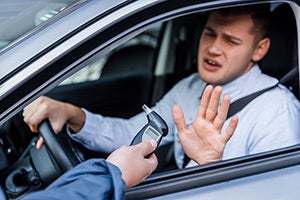
When law enforcement officers pull over a driver suspected of driving under the influence (DUI), breathalyzer exams serve as the primary chemical testing tool used to establish BAC.
However, a breathalyzer reading above the legal limit does not guarantee a DUI conviction. In Los Angeles County and throughout California Superior Courts, experienced criminal defense attorneys frequently challenge, suppress, or discredit breath test results.
Breath testing relies on indirect measurements, strict machine calibration schedules, precise officer observation periods, and specific physiological assumptions—all of which are vulnerable to legal and scientific challenges.
How Do DUI Breathalyzer Tests Work Under California Law?
To understand how breathalyzer results can be defeated in court, it is essential to understand the distinction between preliminary and post-arrest breath tests under California law:
- Preliminary Alcohol Screening (PAS) Test (VC 23136 / VC 23152): Administered at the roadside during a traffic stop, a handheld Preliminary Alcohol Screening (PAS) device is considered a field sobriety test. For drivers 21 and older who are not on DUI probation, taking a PAS test prior to a lawful arrest is generally voluntary.
- Evidentiary Breath Test (Title 17 / VC 23612): Conducted after a formal DUI arrest (either at the police station, a mobile DUI command unit, or jail booking facility), the evidentiary breath test is governed by California Code of Regulations Title 17. Under California's implied consent law (VC 23612), drivers lawfully arrested for a DUI are required to submit to a chemical breath or blood test.
What Key Statutory Regulations Govern Breath Tests?
In California criminal proceedings, prosecutors must show that law enforcement followed strict administrative and scientific guidelines when conducting chemical tests.
-
California Code of Regulations, Title 17: State administrative regulations that establish mandatory procedures for breath, blood, and urine testing. Title 17 requires that breath-testing instruments be properly calibrated, regularly serviced, and operated by trained personnel after a mandatory 15-minute continuous observation period.
-
15-Minute Observation Period: Title 17 requires the arresting officer to observe the driver continuously for at least 15 minutes before the breath test to ensure the suspect does not eat, drink, smoke, vomit, belch, or regurgitate. Failure to maintain continuous observation allows mouth alcohol to contaminate the sample.
-
Partition Ratio Standard: California law assumes a standard conversion ratio of 2,100 to 1 between breath alcohol concentration and blood alcohol concentration. In reality, individual biological partition ratios vary widely based on body chemistry, temperature, and medical conditions, which can lead to falsely elevated BAC readings.
Key Differences at a Glance
|
Legal / Technical Category |
Evidentiary Requirement & Legal Standard |
Defense Impact & Challenge Strategy |
| BAC Legal Threshold | 0.08% BAC or Higher: Unlawful per se under CA Vehicle Code 23152(b) VC. | Margin of Error: Breath devices have an inherent ±0.02% error margin, which can create reasonable doubt near the limit. |
| Title 17 Compliance | Mandatory Protocols: Requires 15 minutes of continuous observation and routine machine calibration. | Procedural Invalidation: Unobserved regurgitation or missing calibration logs can suppress test evidence. |
| Physiological Factors | Deep Lung Assumptions: Assumes a standard 2,100:1 partition ratio and pure alveolar breath air. | Mouth Alcohol Defenses: GERD, acid reflux, or rising BAC inflate readings beyond actual blood alcohol levels. |
What Are the Most Effective Ways to Challenge Breathalyzer Results?
A DUI defense attorney can deploy several established legal, technical, and scientific defense strategies to challenge DUI breathalyzer evidence:
1. Demonstrating Machine Error Rates and Inaccuracy
Breathalyzer devices used by law enforcement agencies across Los Angeles are not infallible. Every machine carries a recognized margin of error (typically ±0.02% BAC). In close cases—such as a driver blowing 0.08% or 0.09%—showing this inherent margin of error creates reasonable doubt about whether the driver was actually at or above the legal limit.
2. Rising Blood Alcohol Defense
Alcohol takes time to absorb into the bloodstream, peaking anywhere from 30 minutes to two hours after drinking. Under the Rising Blood Alcohol Defense, your attorney demonstrates that your BAC was below 0.08% at the time of driving, but continued to rise while you were detained, resulting in a higher BAC reading when tested 45 to 90 minutes later at the police station.
3. Title 17 Violations: Non-Calibration and Lack of Maintenance Log Records
Under Title 17, breathalyzer units must undergo routine accuracy checks and calibration testing (typically every 10 days or 150 uses). Defense attorneys subpoena maintenance logs, calibration records, and repair histories for the specific instrument used. If officers failed to properly calibrate the machine or record maintenance, the test results may be suppressed from evidence.
4. Lack of Officer Training and Improper Test Administration
Police officers must complete specific training programs to operate evidentiary breath testing machines. If the arresting officer failed to follow standard operating procedures, failed to observe the driver continuously for 15 minutes, or failed to collect two separate, valid breath samples within acceptable agreement ranges, the results may be excluded.
5. Medical Conditions: GERD, Acid Reflux, Diabetes, and Mouth Alcohol
Medical conditions such as Gastroesophageal Reflux Disease (GERD), acid reflux, heartburn, or hiatal hernias bring stomach contents and undigested alcohol into the esophagus and mouth. Breathalyzers measure alcohol vapor in deep lung air (alveolar air); when GERD or acid reflux introduces "mouth alcohol," the machine miscalculates the sample, producing artificially high BAC readings. Similarly, low-carb diets (ketosis) or diabetes can produce acetone in the breath, which certain machines mistake for ethanol.
6. Unlawful Traffic Stop and Absence of Probable Cause (PC 1538.5)
Under the Fourth Amendment, police officers must possess reasonable suspicion of a traffic violation or criminal activity to pull over a vehicle. Officers must also establish probable cause before making an arrest. If law enforcement initiates an illegal traffic stop, defense counsel can file a Motion to Suppress Evidence under Penal Code 1538.5 PC to exclude all chemical test results obtained after the illegal detention.
Hypothetical Example of a Successful Breathalyzer Defense
Scenario: The Post-Dinner Traffic Stop
-
The Incident: Elena is pulled over in downtown Los Angeles for driving with a burned-out license plate light. During the stop, the officer notes the smell of alcohol and asks her to perform field sobriety tests, which she largely completes successfully. The officer arrests her and administers a breath test at the station 60 minutes later, recording a BAC of 0.09%.
-
The Medical & Procedural Facts: Elena suffers from chronic acid reflux (GERD) and had eaten a heavy meal shortly before driving. Additionally, station video footage shows the arresting officer left Elena alone in a holding room for 10 minutes to complete paperwork before the test, violating Title 17's 15-minute continuous observation mandate.
-
The Defense Strategy: Elena retains DUI defense counsel. Her attorney files a motion highlighting the Title 17 observation period violation and presents medical documentation of her GERD condition, accompanied by toxicologist testimony explaining how mouth alcohol inflated her reading.
-
The Judicial Outcome: Recognizing that the prosecution cannot establish an accurate, uncorrupted BAC reading at the time of driving beyond a reasonable doubt, the judge suppresses the chemical test results. Prosecutors reduce the charges to a non-alcohol reckless driving disposition ("wet reckless").
Frequently Asked Questions (FAQs)
Can you refuse a breathalyzer test during a traffic stop in California?
If you are 21 or older and not on DUI probation, you can refuse the preliminary roadside PAS breath test before arrest without incurring separate administrative driver's license penalties. However, once you are lawfully arrested, California's implied consent law (VC 23612) requires you to submit to an evidentiary breath or blood test. Refusing a post-arrest chemical test triggers a mandatory one-year DMV license suspension and harsher court penalties.
What is the difference between a roadside breath test and a station breath test?
Roadside PAS tests are preliminary screening devices officers use to establish probable cause for an arrest. Station breath tests (or breath tests conducted on official evidentiary machines) are formal chemical tests governed by Title 17 administrative regulations, and their results are admissible as direct evidence of your BAC in court.
Can food or mints trick a DUI breathalyzer machine?
Breath fresheners, cough drops, mouthwashes, and breath sprays often contain trace amounts of alcohol. Using these products immediately prior to a breath test can trap alcohol in your mouth, resulting in a false, elevated BAC reading. This is why Title 17's mandatory 15-minute observation period is required to ensure mouth alcohol dissipates before testing.
How does GERD affect a breathalyzer test result?
GERD (acid reflux) causes stomach acids and alcohol vapors to travel up the esophagus into the mouth. Because breathalyzers assume all measured alcohol comes exclusively from deep lung air, mouth alcohol caused by GERD tricks the machine into calculating a falsely high BAC level.
Will a DUI charge be dismissed if Title 17 rules were violated?
Not automatically, but Title 17 violations provide powerful grounds to challenge the prosecution's case. Showing that officers failed to follow Title 17 observation or calibration rules lets your attorney move to suppress the breath test evidence or argue to the jury that the test results are fundamentally unreliable.
Speak to a LA DUI Lawyer for Help
Being arrested for a DUI based on a breathalyzer reading of 0.08% or higher can feel overwhelming, but a breath test result is merely physical evidence that can be scrutinized, challenged, and defeated.
From investigating machine calibration logs to consulting expert toxicologists, strategic legal representation is critical to protecting your driving privilege and criminal record.
At Esfandi Law Group, our Los Angeles DUI defense attorney brings decades of trial experience to challenging breathalyzer evidence in Southern California Superior Courts.
We analyze police reports, audit Title 17 compliance records, cross-examine arresting officers on protocol errors, and fight for full charge dismissals or reductions. Contact our LA office today for a confidential consultation by phone or through our website contact form.
